By
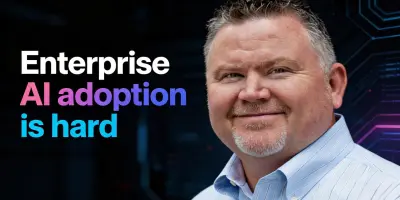
By Guest: Glenn Russell (LinkedIn)
Company: Egen
Show Name: An Eye on AI
Topic: Agentic AI
If 2025 was the year generative AI proved its value, 2026 will be the year AI agents reshape enterprise operations. That’s the view of Glenn Russell, Global AI Practice Lead at Egen, who believes agentic systems — intelligent, task-oriented AI models — will soon become the backbone of enterprise productivity.
📹 Going on record for 2026? We're recording the TFiR Prediction Series through mid-February. If you have a bold take on where AI Infrastructure, Cloud Native, or Enterprise IT is heading—we want to hear it. [Reserve your slot
In his conversation with TFiR host Swapnil Bhartiya, Russell explains that the real value of AI isn’t in the flashiest applications but in the workflows that quietly power every organization. “We’re seeing the large-scale adoption of agent-based technology into core business workflows,” he says. “These systems are becoming integral to how enterprises operate — from HR queries to tax form submissions.”
Agentic AI, Russell notes, goes beyond text generation or chatbots. It represents a new phase of automation where AI systems act as autonomous problem solvers within existing business structures. Built on technologies like Google’s Agent Builder and Anthropic’s platforms, these agents are designed to handle complex operational tasks while collaborating seamlessly with human teams.
The benefits are clear: faster onboarding, quicker issue resolution, higher employee satisfaction, and better customer experiences. “These aren’t glamorous front-end use cases,” Russell says. “They’re back-office improvements — the kind that save time and money at scale.”
Egen sees 2026 as the year when enterprises move beyond the hype cycle of generative AI and start implementing these agentic workflows broadly. The shift, Russell argues, will redefine how companies approach digital transformation. Rather than deploying AI in isolation, they will embed agents directly into the systems and workflows that matter most.
He draws a parallel to previous technological transitions: “Just like we integrated cloud infrastructure and DevOps practices a decade ago, we’ll now see agentic AI become part of every company’s operational fabric.” The focus will be on practical outcomes, not theoretical innovation — measurable improvements in speed, accuracy, and employee productivity.
While the technology providers vary — from Google to Anthropic and others — Russell emphasizes that the choice of model is secondary. “The technology doesn’t matter as much as the outcome,” he says. “What matters is making workflows quick, accurate, and responsive.”
For leaders preparing their organizations for this next phase, the takeaway is clear: start identifying the repetitive, rule-based processes that could benefit from agentic systems. Those early integrations will form the foundation for larger, enterprise-wide transformation.
In Russell’s view, the rise of agentic AI marks a maturing of enterprise AI — from experimentation to embedded intelligence. As more companies deploy these agents into everyday workflows, 2026 may well be remembered as the year business automation truly became intelligent.