By
By 
The technology landscape is rapidly evolving with AI, and as companies scale, the need for more advanced tools to manage vast infrastructures has become essential. At Intuit, we are at the forefront of this shift, leveraging AI and open-source technologies to create a future-proof, AI-native platform that serves our extensive developer community and powers our industry-leading products like QuickBooks, TurboTax, Mailchimp, and Credit Karma.
A Journey from Cloud-Native to AI-Native
Intuit’s journey began in 2018 with the adoption of cloud-native technologies. Today, our infrastructure consists of more than 325 Kubernetes clusters, managing 28,000 namespaces that support around 2,500 production services alongside numerous pre-production environments. This infrastructure fuels a development community of 8,000 engineers across 1,000 teams, enabling innovation at scale.
📹 Going on record for 2026? We're recording the TFiR Prediction Series through mid-February. If you have a bold take on where AI Infrastructure, Cloud Native, or Enterprise IT is heading—we want to hear it. [Reserve your slot
However, in 2023, we embarked on a new path — transitioning from cloud-native to AI-native. The vision behind this move is clear: by integrating AI into every layer of our platform, we aim to triple developer velocity over the next few years.
Building Modern SaaS AIR: An AI-Native Platform for Developers
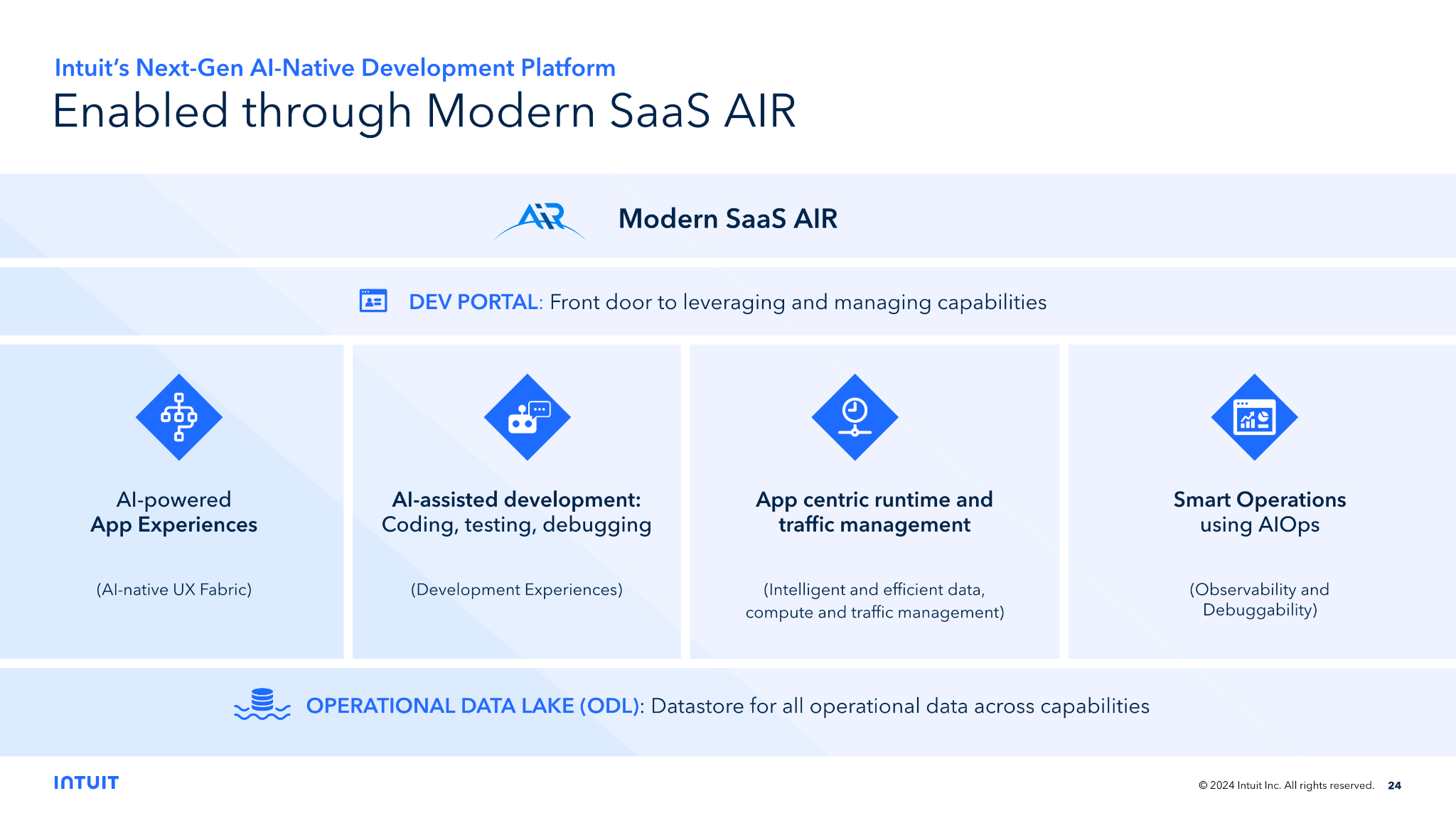
Our goal is to create an environment where developers can build, deploy, and manage applications seamlessly, all while leveraging the power of AI to enhance efficiency. The Modern SaaS AIR (AI Runtime / AI Revolution, you pick!) platform is central to this vision, designed to support Intuit’s vast developer community with cutting-edge tools and AI-driven experiences.
Key areas of focus in this transition include:
1. Building AI-Powered Customer Experiences
To accelerate the creation of AI-powered customer experiences, we built the UX Fabric platform — a repository of reusable components standardized across the organization. This platform includes GenUX, a user experience (UX) framework with over 140 new components designed to offer consistent and intuitive customer interactions across desktop and mobile devices. The GenUX library is AI-ready, featuring built-in large language model (LLM) connections and feedback loops for continuous improvement.
By embedding performance and instrumentation tools directly into the platform, developers can ensure that applications are both fast and reliable across all devices. Intuit is leveraging this platform to build AI-driven experiences that power millions of users, ensuring each customer interaction is efficient and personalized.
2. Empowering Developers with AI Development Tools
Developers are at the heart of Intuit’s innovation, and providing them with the best tools is a priority. Using AI for code generation, we’ve streamlined the software development lifecycle. Intuit’s proprietary Generative AI Operating System (GenOS) analyzes developer support documentation, logs, and historical patterns to accelerate the development process. By integrating these insights into tools like Slack, integrated development environments (IDEs), and the developer portal, we’ve significantly improved developer efficiency.
With this approach, we’re seeing gains of up to 30% in development velocity, thanks to AI-driven automation that standardizes code, documentation, and testing procedures. The result is faster delivery times, higher-quality code, and reduced time spent on manual processes like testing and integration.
3. Intelligent Auto-Scaling and Self-Healing Runtime
Managing the scale of modern applications requires automation and intelligence. Intuit’s IKS AIR platform, built on Kubernetes, provides an abstracted, application-centric runtime that automatically adjusts to traffic and performance demands. Leveraging historical operational data, IKS AIR tunes itself, scaling applications intelligently to ensure performance without requiring developers to manage the underlying infrastructure.
In addition, our platform simplifies traffic management, combining API gateway and service mesh configurations into a unified interface. This reduces the complexity of managing microservices and API endpoints, while providing developers with powerful debugging tools like ephemeral containers and one-click debugging. These features, supported by open-source tools like Argo Workflows, help developers troubleshoot issues faster and maintain application integrity.
4. Infusing AI into Operations with AIOps
At Intuit, we are leveraging AI to power our operational excellence goals, particularly in reducing Mean Time to Resolution (MTTR) and Mean Time to Detection (MTTD) by 50%. With AIOps, our platform uses real-time operational data to automatically detect, isolate, and remediate production issues, minimizing downtime and ensuring a stable application environment.
Our Numaflow-powered anomaly detection and root cause summarization tools, integrated into platforms like ArgoCD, provide actionable insights in real time. This automation allows developers to focus on innovation rather than firefighting, helping reduce manual intervention and improving overall system reliability.
Open Source as the Foundation for AI Innovation
Open-source technologies have played a pivotal role in the development of Intuit’s AI-native platform. Projects like Kubernetes, Argo CD & Workflows, Istio, Admiral, and Numaflow form the backbone of our infrastructure, enabling us to build scalable, reliable systems that can adapt to the ever-changing needs of modern software development.
By continuing to invest in open-source communities & giving back, we are helping to shape the future internal development platforms powered by AI. These technologies allow us to stay agile, continuously improving our platform and empowering developers with the tools they need to build the next generation of AI-driven applications.
As we continue this journey, we remain committed to pushing the boundaries of innovation, building tools that empower our developers and ultimately deliver better outcomes for our customers.
Follow our Open Source page to stay updated on the latest developments.
To learn more about Kubernetes and the cloud native ecosystem, join us at KubeCon + CloudNativeCon North America, in Salt Lake City, Utah, on November 12-15, 2024.