By
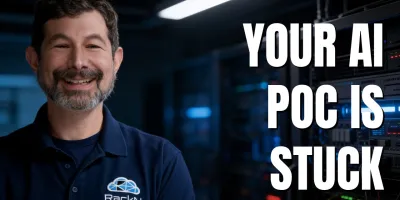
By Broadcom’s changes to VMware have created significant challenges, prompting enterprises to reassess their virtualization strategies and explore alternative solutions. In this episode, Rob Hirschfeld, CEO and Co-Founder of RackN, discusses key concerns with VMware under Broadcom‘s ownership, the importance of architectural considerations when migrating from VMware, and how RackN’s Digital Rebar is helping solve these challenges. He says, “A lot of companies are looking for who and how they’re going to fill those holes, some of which RackN is certainly happy to step in with integrated automation and orchestration.”
What are the key concerns of VMware under Broadcom?
- Hirschfeld tells us that while many customers and prospects have quickly shifted their perception of Broadcom as a preferred vendor, this shift has not led to immediate actions like deleting VMware.
- Hirschfeld discusses the main concerns customers have with VMware under Broadcom, highlighting price increases and bundled product requirements as significant issues.
- Hirschfeld emphasizes that architecture is crucial when migrating from VMware. VMware’s flexible architecture allows customized solutions, which alternatives lack, making this a key consideration along with application integration.
Key strategies to avoid vendor lock-in
- Enterprises need modern architectural patterns like ephemeral and cloud-like infrastructure for deployment flexibility, requiring investments in CICD and dynamic system management.
- Hirschfeld stresses the importance of avoiding vendor lock-in by investing in abstractions that facilitate multi-vendor environments.
- Hirschfeld advocates for deliberate choices in selecting platforms that best fit specific workloads, enabling flexibility and innovation without being tied to single-vendor solutions.
Advice for companies to integrate multi-vendor, abstracted environments
- Hirschfeld advises against attempting to fully eliminate VMware, emphasizing that setting realistic goals to gradually reduce VMware’s footprint while integrating multi-vendor, abstracted environments is more practical and achievable.
- Companies need to focus on creating flexibility and skill-building to manage operational debt effectively, recommending a structured approach using criteria and scoring to prioritize and execute migrations systematically.
- Hirschfeld advises focusing on building processes around resource consumption that include consistent automation pipelines with abstraction layers. He explains that these layers foster flexibility and future-proofing infrastructure decisions.
How RackN supports companies migrating from VMware
- Hirschfeld talks about how RackN supports companies looking to migrate from VMware or deploy alternatives, emphasizing their focus on being an open, multi-vendor platform by standardizing deployments of VMware alternatives.
- RackN virtualization systems automation also provides flexibility allowing customers to transition between platforms seamlessly.
How alternative solutions are filling the gap since Broadcom’s acquisition of VMware
- Hirschfeld talks about Broadcom’s response to market feedback post-acquisition of VMware, noting that he had heard concerns from customers about Broadcom’s actions but has not seen significant changes in their strategy yet.
- Hirschfeld points out enterprises’ heavy dependence on VMware’s UI, tooling, orchestration, and automation, which complicates integrating other technologies like Kubernetes. Moving away from VMware requires replacing not just the virtualization layer but also other essential components.
- Collaborations with Red Hat and their solutions like OpenShift and Ansible help fill some gaps but require additional integration. Companies should prioritize building automation and adopting best practices to navigate these complexities.
Why companies need to automate their build processes from the onset
- Hirschfeld stresses the risk of building bespoke solutions by hand initially, urging companies to automate their build processes from the outset.
- It is important to adopt a developer mindset in operations, implementing a Dev, Test, and Prod pipeline to continuously test and rebuild infrastructure. Hirschfeld explains the benefits of this approach, which is so foundational to Digital Rebar.
- Hirschfeld encourages organizations to integrate these practices early on to transform their infrastructure management and deployment strategies effectively.
Guest: Rob Hirschfeld (LinkedIn)
Company: RackN (Twitter)
Show: Let’s Talk
This summary was written by Emily Nicholls.