By
By Migrating a data center is never easy, but when you’re dealing with 40,000 servers across 10 sites, power constraints, and VMware upgrades—all within a six-week timeline—the challenges become even more intense.
In this Success Story, we explore how a RackN customer successfully executed a massive infrastructure overhaul while optimizing costs, improving performance, and future-proofing their operations.
The Driving Force Behind the Migration
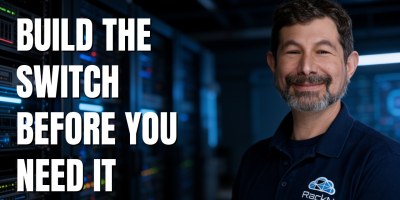
Rob Hirschfeld, CEO and Co-Founder of RackN, explains that the biggest challenge for this customer was power constraints. “The top constraint companies have is they can’t expand without getting more power.” With no option to build new data center space, they had to rethink their entire architecture.
Additionally, pressure from VMware upgrades and supply chain considerations made incremental updates impractical. Instead, they completely re-architected their infrastructure, moving from Intel to AMD systems for better power efficiency and performance.
Execution at Scale: Speed, Strategy, and Automation
The customer took an aggressive approach, leveraging reverse auctions to bid vendors against each other. By purchasing 40,000 servers in bulk, they negotiated significant cost savings. But that also meant they had to decommission 40,000 servers—a task that required automation to ensure security and efficiency.
“One surprising challenge was decommissioning,” Hirschfeld notes. “You don’t realize how complex it is until you have to wipe credentials, reset BIOS, and certify the process for thousands of machines at once.”
Thanks to standardized and automated processes, the migration was completed in just six weeks, with a total project timeline of three months—a fraction of the time typically required for such large-scale transformations.
ROI: Savings, Performance, and Future Readiness
Despite the scale of this migration, the return on investment (ROI) was under six months. By replacing aging hardware with more power-efficient systems, the customer:
- Doubled performance while reducing power consumption by 50%
- Avoided costly expansion by optimizing space usage
- Upgraded VMware infrastructure to eliminate technical debt
- Reduced long-term vendor lock-in through a multi-vendor strategy
Key Takeaways for IT Leaders
This story highlights the benefits of aggressive infrastructure modernization:
-
- Plan for power and space constraints early
- Automate onboarding and decommissioning to reduce risk
- Leverage bulk purchasing power for better vendor deals
- Standardize and rehearse processes to ensure smooth execution
For organizations looking to scale efficiently, this case proves that bold, well-planned transformations can drive major cost savings and performance gains.
Guest: Rob Hirschfeld (LinkedIn)
Company: RackN
Show: Success Story